
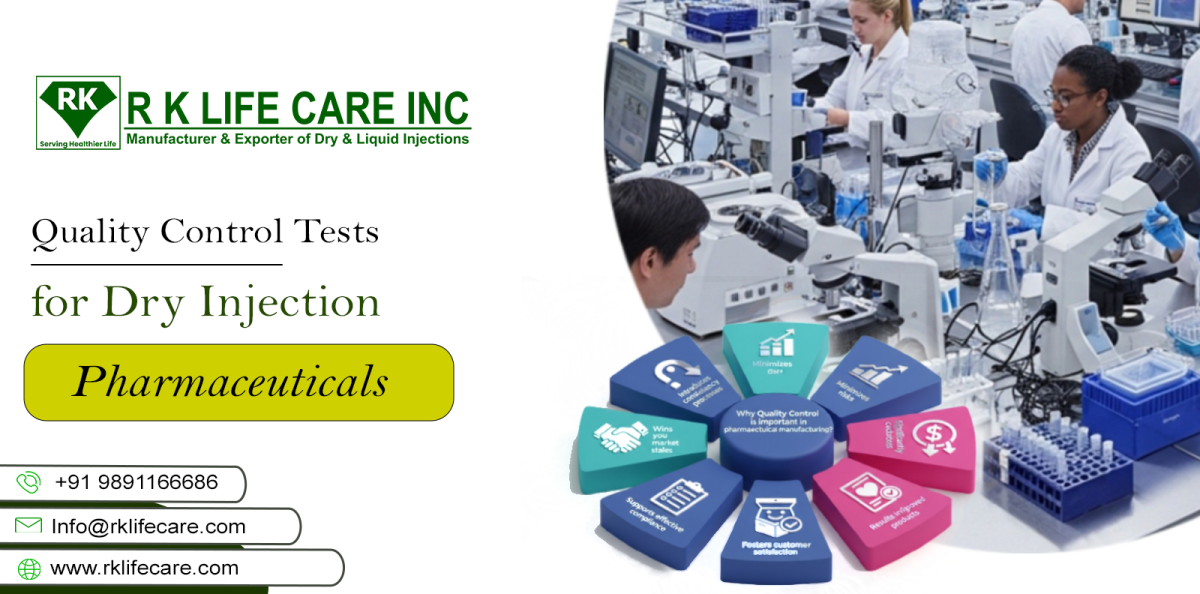
Have you ever considered how injectable medicines maintain their safety and effectiveness before reaching patients? In the pharmaceutical industry, even a minor quality issue can lead to serious health risks. This is especially critical for dry injections, which are directly administered into the body.
Quality control tests for dry injection pharmaceuticals play a crucial role in ensuring that these medicines meet strict safety, sterility, and efficacy standards. From manufacturing to final packaging, every stage undergoes rigorous testing to maintain global quality benchmarks.
A single contamination in an injectable drug can risk a patient’s life within minutes, making quality control not just important—but critical.
What are Quality Control Tests for Dry Injection Pharmaceuticals?
Quality control tests for dry injection pharmaceuticals are procedures used to ensure:
- Sterility of the product
- Accurate drug potency
- Stability during storage
- Safety for patient use
These tests help pharmaceutical companies deliver reliable products that comply with international standards such as WHO-GMP and other regulatory guidelines.
What are Dry Injection Pharmaceuticals?
Dry injections, also known as lyophilized injections, are sterile powder formulations that require reconstitution before use. These are commonly used for antibiotics, vaccines, and sensitive drugs that degrade quickly in liquid form.
The manufacturing process involves lyophilization (freeze-drying), which removes moisture and enhances drug stability. However, due to this complex process, maintaining quality becomes even more important.
Importance of Quality Control in Dry Injections
Quality control tests for dry injection pharmaceuticals ensure:
- Sterility and absence of contamination
- Accurate dosage and drug potency
- Stability during storage and transport
- Compliance with regulatory requirements
In injectable pharmaceuticals, there is zero margin for error. Even a minor deviation in an injectable formulation can have immediate and serious consequences for patient health.
Key Quality Control Tests for Dry Injection Pharmaceuticals
1. Sterility Testing
Ensures the product is completely free from microorganisms.
2. Bacterial Endotoxin Test (BET)
Detects harmful endotoxins that may cause fever or shock.
3. Moisture Content (Karl Fischer Method)
Ensures minimal moisture for better stability and shelf life.
4. Reconstitution Time Test
Evaluates how quickly the powder dissolves in a solvent.
5. Particulate Matter Test
Ensures absence of visible and sub-visible particles.
6. Assay (Potency Test)
Confirms the correct amount of active ingredient.
7. pH Measurement
Checks compatibility with the human body.
8. Uniformity of Content
Ensures consistent dosage in every vial.
9. Container Closure Integrity Test (CCIT)
Ensures proper sealing and protection from contamination.
Quick Overview of Quality Control Tests
| Test Name | Purpose |
|---|---|
| Sterility Testing | Detects microorganisms |
| BET | Identifies endotoxins |
| Moisture Test | Ensures stability |
| Assay | Confirms drug potency |
| CCIT | Ensures packaging integrity |
Regulatory Standards and Compliance
Pharmaceutical companies must follow strict international guidelines, such as WHO-GMP, to ensure product quality. These standards require proper documentation, regular audits, and validated processes.
These practices are aligned with globally accepted guidelines provided by international health authorities, ensuring safety and consistency in pharmaceutical products.
Role of Technology in Quality Control
Modern advancements have significantly improved quality control tests for dry injection pharmaceuticals through:
- Automated inspection systems
- Real-time monitoring tools
- Advanced analytical techniques
These technologies reduce human error and enhance accuracy, ensuring consistent product quality.
Industry Approach to Quality Assurance
Pharmaceutical companies involved in injectable manufacturing and third-party pharma manufacturing must follow strict quality control standards and maintain sterile environments.
Organizations such as Rk Life Care Inc reflect this industry-wide commitment by aligning their manufacturing and quality control systems with global standards. Their approach highlights how consistent testing ensures safe and reliable pharmaceutical products.
Challenges in Quality Control of Dry Injections
Maintaining quality control tests for dry injection pharmaceuticals can be challenging due to:
- Complex lyophilization process
- Sensitivity to environmental conditions
- High cost of compliance
- Requirement for skilled professionals
Conclusion
Quality control tests for dry injection pharmaceuticals are essential to ensure drug safety, effectiveness, and reliability. From sterility testing to potency analysis, each step plays a vital role in maintaining pharmaceutical quality.
In an industry where patient safety is paramount, quality control is not optional—it is a responsibility. Companies across the pharmaceutical sector, including Rk Life Care Inc, demonstrate how strong quality systems contribute to better healthcare outcomes.
As demand for injectable medicines continues to grow, the importance of quality control tests for dry injection pharmaceuticals will only increase. Ultimately, these tests form the foundation of trust in modern pharmaceutical manufacturing.
Choosing a pharmaceutical partner with strong quality control systems is essential for ensuring safe and effective injectable medicines.
Comments
No comments yet. Be the first to share your thoughts!
Leave a Comment