
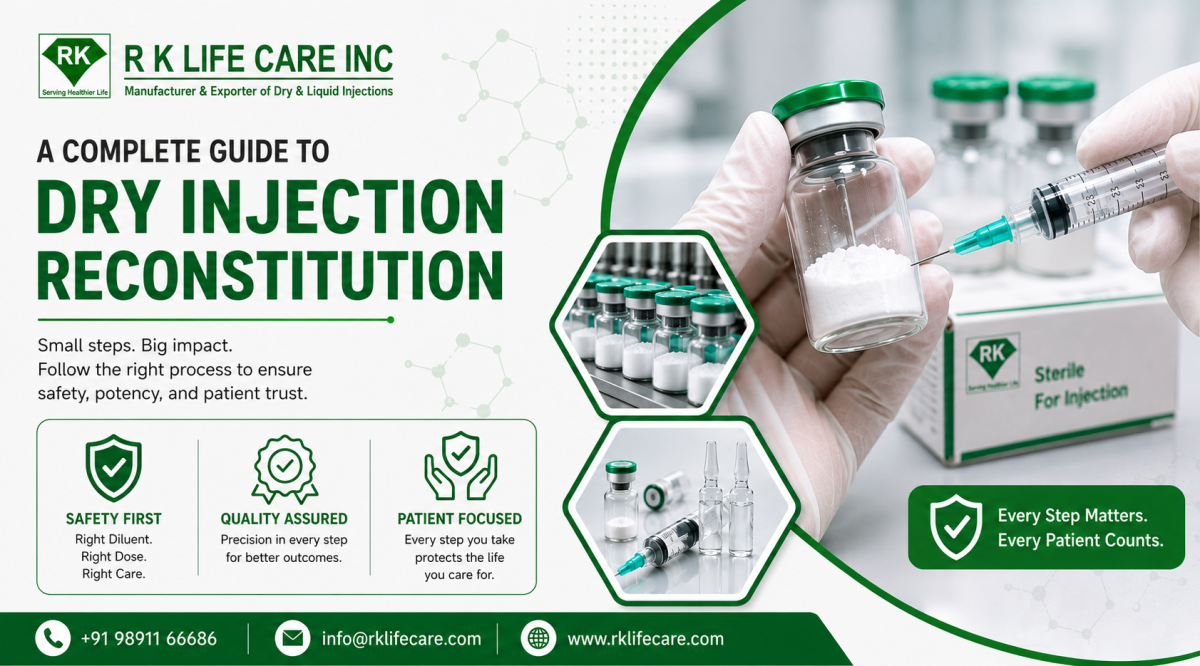
Many injectable medications — certain antibiotics, vaccines, hormones, and biologics — are supplied as a dry (lyophilized) powder rather than a ready-to-use liquid. This is usually because the active drug is unstable in solution over time. Before these medications can be administered, they must be reconstituted: mixed with an appropriate diluent to form a solution or suspension.
Reconstitution seems simple, but small errors — the wrong diluent, incorrect volume, poor technique, or contamination — can compromise drug potency, patient safety, or both. This guide walks through the process step by step, with the precautions that matter most.
Why Reconstitution Requires Care
Dry powder injectables are formulated the way they are for a reason. Getting reconstitution wrong can lead to:
- Reduced potency — under-dosing due to incomplete dissolution or degradation
- Overdosing or underdosing — using the wrong final concentration
- Contamination — introducing microbes during preparation
- Physical incompatibility — precipitation, cloudiness, or gas formation from using the wrong diluent
- Patient discomfort or harm — from incorrect osmolarity, pH, or particulate matter
Because of this, reconstitution should always follow the manufacturer's package insert exactly, and only be performed by trained personnel following facility protocols.
Step 1: Gather Supplies and Verify the Order
Before touching the vial, confirm:
- The correct medication, strength, and lot number
- The expiration date of both the powder vial and the diluent
- The prescribed dose and route of administration
- The manufacturer-specified diluent (e.g., Sterile Water for Injection, Bacteriostatic Water, Normal Saline, or a specific proprietary diluent)
- That the vial has been stored correctly (temperature, light protection) and shows no visible damage
Assemble a clean workspace with the vial, diluent, appropriately sized syringe and needle, alcohol swabs, and a sharps container.
Step 2: Perform Hand Hygiene and Prepare the Workspace
-
Wash hands thoroughly or use an alcohol-based hand rub.
- Wear gloves if required by facility policy.
- Work on a clean, disinfected surface, ideally under a laminar flow hood for sterile compounding in a pharmacy setting.
- Avoid preparing medications in areas with heavy traffic, drafts, or open windows.
Step 3: Inspect Both Vials
- Check the powder vial for discoloration, caking, or moisture (which can indicate prior exposure to humidity or heat).
- Check the diluent for clarity, correct type, and an intact seal.
- Never use a vial with a compromised seal, particulate matter, or unusual color.
Step 4: Disinfect the Vial Tops
- Wipe both rubber stoppers with a 70% isopropyl alcohol swab.
- Allow the alcohol to air-dry completely (this typically takes about 30 seconds) — wiping while still wet reduces its antiseptic effect and can push residue into the vial when punctured.
Step 5: Draw Up the Diluent
- Using a sterile syringe, draw air into the syringe equal to the volume of diluent you will withdraw.
- Insert the needle into the diluent vial and inject the air (this equalizes pressure and makes withdrawal easier).
- Invert the vial and withdraw the exact volume of diluent specified by the manufacturer. Precision matters — even small volume errors change the final concentration.
Step 6: Add the Diluent to the Powder Vial
- Insert the needle into the powder vial at an angle, directing the stream of diluent against the inside wall of the vial rather than directly onto the powder.
- Injecting diluent directly onto the powder can cause excessive foaming, incomplete dissolution, or localized denaturation of sensitive proteins (relevant for many biologics).
- Do not force air into a vial that is already vacuum-sealed unless the instructions call for it; some vials rely on vacuum to help draw in the diluent.
Step 7: Mix Gently — Don't Shake
- Most powders should be gently swirled or rolled between the palms, not shaken.
- Vigorous shaking can denature proteins (especially in biologic drugs) or cause excessive foam, making it hard to draw an accurate dose.
- Some formulations do specify shaking — always defer to the specific product's instructions.
- Continue mixing until the powder is fully dissolved with no visible particles, clumps, or haze, unless the product is intended to be a suspension (check the insert — some products remain cloudy by design).
Step 8: Inspect the Reconstituted Solution
Before drawing up a dose, check for:
- Complete dissolution (unless a suspension is expected)
- Absence of visible particles, fibers, or discoloration
- Normal clarity and color as described in the product insert
If anything looks abnormal, do not administer it — discard according to protocol and start again with a new vial.
Step 9: Label the Vial
Once reconstituted, many powders have a limited stability window (often just hours to a few days, even under refrigeration). Label the vial immediately with:
- Date and time of reconstitution
- Final concentration
- Expiration date/time after reconstitution
- Initials of the person who prepared it
Step 10: Draw Up and Administer the Correct Dose
- Use a new, appropriately sized syringe and needle to withdraw the prescribed dose.
- Expel air bubbles carefully to avoid dosing errors.
- Administer via the correct route (IV, IM, subcutaneous) as prescribed, following standard aseptic injection technique.
Step 11: Store or Discard Appropriately
- If not used immediately, store the reconstituted vial per the manufacturer's guidance (often refrigerated, and often single-use only).
- Discard any unused portion after the stated beyond-use time, even if it appears fine — visual clarity does not guarantee sterility or potency.
- Dispose of needles and vials in an approved sharps container.
A Quick Safety Checklist
- ✅ Confirm the correct drug, diluent, and volume from the package insert
- ✅ Inspect both vials before use
- ✅ Disinfect and air-dry vial tops
- ✅ Add diluent along the vial wall, not directly onto the powder
- ✅ Mix gently; avoid shaking unless directed
- ✅ Inspect the final solution before use
- ✅ Label with time, concentration, and expiry
- ✅ Follow facility protocols for storage and disposal
Final Thoughts
Reconstituting dry powder injections is a routine task in clinical settings, but "routine" doesn't mean low-stakes. Every step — from diluent selection to mixing technique to labeling — protects both drug efficacy and patient safety. When in doubt, the manufacturer's package insert is always the definitive source, and any uncertainty should be resolved with a pharmacist before administration.
Comments
No comments yet. Be the first to share your thoughts!
Leave a Comment