
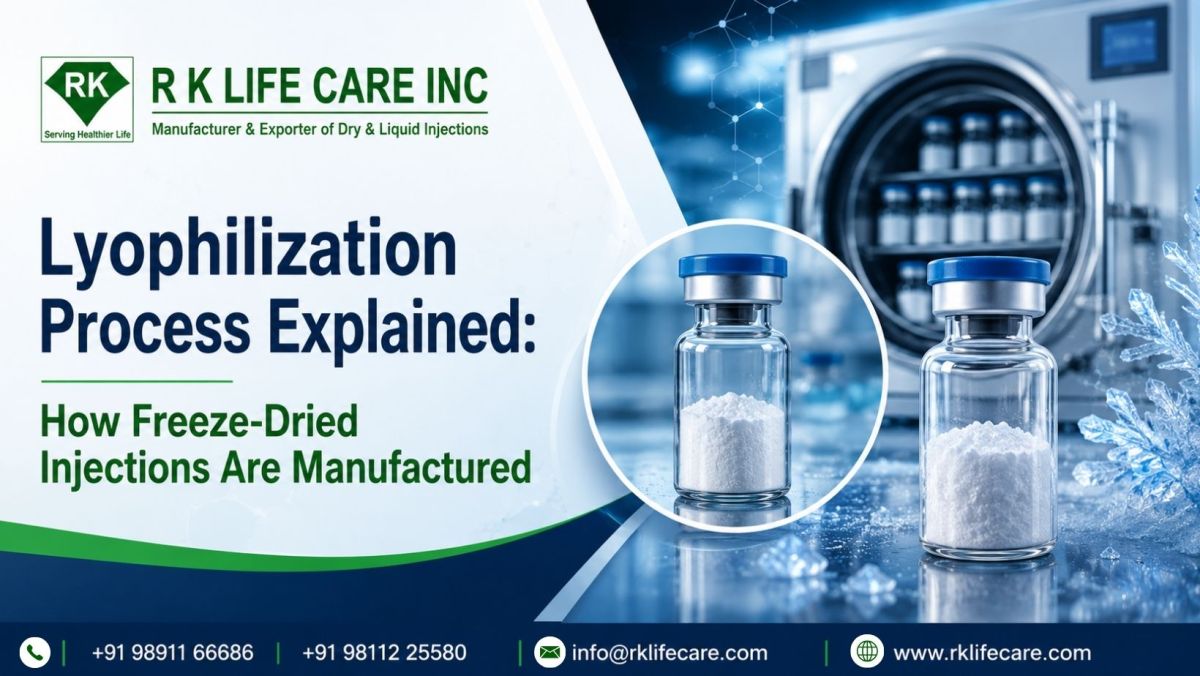
In the pharmaceutical industry, maintaining the stability and effectiveness of sensitive medicines is one of the biggest challenges. Many injectable drugs, including antibiotics, biologics, and vaccines, can lose their potency when exposed to moisture or heat. This is where the lyophilization process, commonly known as freeze-drying, plays a crucial role.
Lyophilization is an advanced pharmaceutical manufacturing technique that removes water from a product while preserving its chemical structure, potency, and shelf life. Today, freeze-dried injections are widely used because they offer improved stability, easier transport, and longer shelf life compared to conventional liquid formulations.
As pharmaceutical manufacturers continue to adopt advanced production technologies, companies like RK Life Care Inc also focus on manufacturing processes that align with quality standards and regulatory requirements for injectable formulations.
What Is Lyophilization?
Lyophilization is a dehydration process in which water is removed from a frozen pharmaceutical product through sublimation. Instead of melting into liquid, the ice changes directly into vapor under controlled vacuum conditions.
The process is especially suitable for heat-sensitive drugs that may degrade during traditional drying methods. Once the product is freeze-dried, it forms a porous cake inside the vial, allowing healthcare professionals to reconstitute it with sterile water before administration quickly.
This technique has become an essential part of modern sterile injectable manufacturing because it helps preserve product quality over extended periods.
Why Are Freeze-Dried Injections Preferred?
Freeze-dried injections offer several advantages over liquid injectable formulations.
Some of the key benefits include:
- Longer shelf life due to minimal moisture content.
- Better stability for temperature-sensitive drugs.
- Reduced risk of chemical degradation.
- Easier storage and transportation.
- Faster reconstitution before patient administration.
- Improved product consistency throughout its lifecycle.
These advantages make lyophilized products highly suitable for antibiotics, oncology drugs, peptides, vaccines, and other specialized pharmaceutical formulations.
Step-by-Step Lyophilization Process
Understanding how freeze-dried injections are manufactured helps explain why the process requires advanced equipment and strict quality control.
1. Drug Formulation Preparation
The process begins with preparing the sterile drug solution. Active pharmaceutical ingredients (APIs) are mixed with suitable excipients that improve stability during freezing and drying.
The formulation undergoes extensive testing to ensure compatibility, pH balance, and sterility before filling.
2. Sterile Filling into Vials
The prepared solution is aseptically filled into sterilized glass vials using automated filling lines. Maintaining a sterile environment at this stage is critical to prevent contamination.
The vials are then partially stoppered before entering the freeze dryer.
3. Freezing Stage
Inside the lyophilizer, the filled vials are cooled to extremely low temperatures, usually between -40°C and -50°C.
This step freezes the water present in the formulation while maintaining the structure of the active drug. Proper freezing ensures uniform drying during the next stages.
4. Primary Drying (Sublimation)
After freezing, a high vacuum is applied inside the chamber.
Controlled heat is gradually introduced, allowing ice to convert directly into vapor without passing through the liquid phase. This stage removes nearly 95% of the water content while preserving the integrity of the pharmaceutical product.
Primary drying is considered the most critical phase of lyophilization.
5. Secondary Drying
Even after sublimation, a small amount of bound moisture remains within the product.
During secondary drying, the temperature is slightly increased to remove residual moisture, resulting in a highly stable freeze-dried product with excellent shelf life.
6. Stoppering and Sealing
Once drying is complete, the vials are fully stoppered under vacuum and sealed with aluminum caps.
The finished product is then inspected, labeled, and packaged according to pharmaceutical quality standards before distribution.
Quality Control in Lyophilized Injection Manufacturing
Quality assurance is an essential part of freeze-dried injection production.
Manufacturers perform multiple quality tests, including:
- Sterility testing
- Moisture content analysis
- Cake appearance inspection
- Reconstitution time evaluation
- Potency testing
- Particulate matter analysis
- Container closure integrity testing
Following Good Manufacturing Practices (GMP) and validated manufacturing procedures ensures that every batch meets safety, efficacy, and regulatory requirements.
Organizations such as RK Life Care Inc understand the importance of maintaining stringent quality standards throughout pharmaceutical manufacturing, especially for sterile injectable products where precision and consistency are essential.
Applications of Freeze-Dried Injections
Lyophilization is commonly used for manufacturing various pharmaceutical products, including:
- Antibiotics
- Oncology medicines
- Vaccines
- Hormonal injections
- Biologics
- Peptide formulations
- Emergency injectable drugs
As the global pharmaceutical market continues to expand, demand for freeze-dried injectable medicines is expected to grow due to their superior stability and ease of handling.
Challenges in the Lyophilization Process
Although lyophilization offers several benefits, it is also one of the most technically demanding pharmaceutical manufacturing processes.
Some common challenges include:
- Long production cycles
- High equipment investment
- Process optimization requirements
- Maintaining product uniformity
- Preventing vial contamination
- Ensuring consistent moisture removal
To overcome these challenges, manufacturers rely on advanced freeze dryers, automated monitoring systems, validated production protocols, and skilled technical teams.
Conclusion
Lyophilization has transformed the way sensitive injectable medicines are manufactured by significantly improving their stability, safety, and shelf life. From sterile formulation preparation and freezing to vacuum drying and final packaging, every stage requires careful control and adherence to pharmaceutical quality standards.
As injectable therapies continue to evolve, freeze-dried formulations will remain a vital part of modern healthcare. Companies such as RK Life Care Inc recognize the importance of robust manufacturing practices, quality assurance, and regulatory compliance in producing reliable pharmaceutical products that meet industry expectations. Understanding the lyophilization process not only highlights the science behind freeze-dried injections but also emphasizes the precision required to deliver safe and effective medicines to patients worldwide.
Comments
No comments yet. Be the first to share your thoughts!
Leave a Comment