
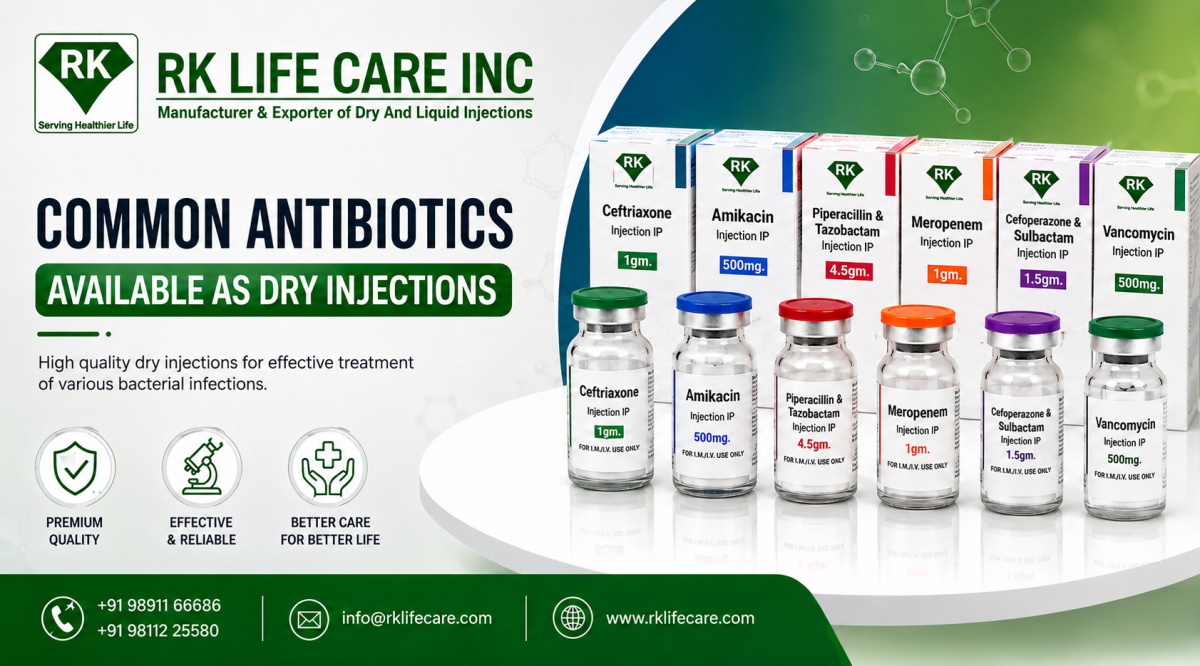
Many of the antibiotics available as dry injections in hospitals and clinics today are supplied as lyophilized powder rather than ready-to-use liquids. This isn't a manufacturing preference — it's a chemical necessity. Beta-lactam antibiotics, in particular, tend to break down quickly once dissolved in water, so they're kept in powder form and reconstituted with a diluent shortly before administration.
At RK Life Care Inc, understanding these formulations is part of how pharmacy teams and healthcare providers can handle them correctly. Here's a look at some of the most common antibiotics available as dry injections, why they're formulated this way, and what makes each one clinically important.
Why Are So Many Antibiotics Sold as Dry Powder?
Antibiotics like penicillins and cephalosporins contain a beta-lactam ring — a chemical structure that's highly effective against bacteria but also unstable in aqueous solution. Once dissolved, these drugs start to hydrolyze (break down) over time, losing potency. Keeping them as a dry powder until just before use preserves their effectiveness and extends shelf life significantly, often allowing storage at room temperature for months or years instead of days. For a deeper look at how these powders reach the vial in the first place, see our earlier guide on how freeze-dried injections are manufactured.
Common Antibiotics Available as Dry Injections
1. Ceftriaxone
Ceftriaxone is a third-generation cephalosporin widely used for a broad range of bacterial infections, including respiratory tract infections, meningitis, skin infections, and certain sexually transmitted infections. It's popular in hospital settings partly because of its long half-life, which allows for once-daily dosing in many cases. It's typically reconstituted with sterile water, saline, or dextrose solution depending on the intended route of administration (IV or IM).
2. Amoxicillin (Injectable Forms)
While amoxicillin is more commonly known as an oral antibiotic, injectable formulations — often combined with clavulanic acid — are used in hospital settings for more serious infections or when oral administration isn't practical. As a penicillin-class antibiotic, it shares the same beta-lactam instability that makes powder form necessary for the injectable version.
3. Ampicillin
Ampicillin, a broad-spectrum penicillin, is commonly used for infections of the respiratory tract, urinary tract, and gastrointestinal system, as well as in certain cases of meningitis. It's frequently reconstituted with sterile water for injection and is known for being particularly sensitive to degradation once dissolved, meaning it often has a shorter window for use after reconstitution compared to other antibiotics.
4. Cefotaxime
Another third-generation cephalosporin, cefotaxime is used for a wide range of serious infections, including septicemia, meningitis, and complicated urinary tract infections. It's especially valued for its ability to cross the blood-brain barrier reasonably well, making it useful in central nervous system infections.
5. Piperacillin-Tazobactam
This combination antibiotic pairs a broad-spectrum penicillin with a beta-lactamase inhibitor, making it effective against a wider range of resistant bacteria. It's commonly used in hospital settings for serious infections like hospital-acquired pneumonia and complicated intra-abdominal infections. It is supplied strictly as a powder for reconstitution due to its combination formulation.
6. Meropenem
A carbapenem-class antibiotic, meropenem is often reserved for severe or multidrug-resistant infections when other antibiotics haven't worked. Because of its potency and the seriousness of the infections it treats, meropenem is almost always administered in hospital settings under close supervision, and it must be reconstituted and used within a short timeframe after mixing.
7. Vancomycin
Though technically a glycopeptide rather than a beta-lactam, vancomycin is another antibiotic commonly supplied as a dry powder, largely due to stability concerns. It's a critical drug for treating serious infections caused by resistant Gram-positive bacteria, including certain MRSA infections, and requires careful reconstitution and administration due to its narrow therapeutic window.
Quick Reference Table
| Antibiotic | Drug Class | Common Use | Key Note |
|---|---|---|---|
| Ceftriaxone | 3rd-gen cephalosporin | Respiratory, meningitis, skin infections | Long half-life, once-daily dosing |
| Amoxicillin (injectable) | Penicillin | Serious infections, hospital use | Often combined with clavulanic acid |
| Ampicillin | Penicillin | Respiratory, urinary, GI infections | Degrades quickly once reconstituted |
| Cefotaxime | 3rd-gen cephalosporin | Septicemia, meningitis, UTIs | Crosses blood-brain barrier well |
| Piperacillin-Tazobactam | Penicillin + inhibitor | Hospital-acquired pneumonia, abdominal infections | Effective against resistant bacteria |
| Meropenem | Carbapenem | Severe, multidrug-resistant infections | Short window after reconstitution |
| Vancomycin | Glycopeptide | Resistant Gram-positive infections (e.g., MRSA) | Narrow therapeutic window |
What This Means for Pharmacies and Healthcare Providers
Because these antibiotics are only stable for a limited time once reconstituted, correct handling matters significantly:
- Use the manufacturer-specified diluent — using the wrong one can cause precipitation or reduced potency
- Follow beyond-use dating strictly — most reconstituted antibiotics must be used within hours, even under refrigeration
- Label immediately with time of preparation and expiry
- Never assume interchangeability between different brands or formulations without checking the product insert
For a full walkthrough of the reconstitution process itself, see our step-by-step guide on how to reconstitute dry powder injections safely. If you're also comparing formulation types more broadly, our post on dry injection vs liquid injection differences covers the stability and storage trade-offs in more depth.
At RK Life Care Inc, this kind of formulation-specific handling knowledge is part of why proper storage, reconstitution training, and quality-checked supply matter just as much as the drug itself — a well-manufactured antibiotic can still lose its effectiveness if mishandled after the vial is opened.
Antibiotic misuse and improper handling also contribute to a larger global concern — for more on this, the World Health Organization's page on antimicrobial resistance outlines why correct dosing, storage, and administration practices matter beyond just individual patient outcomes.
Final Thoughts
Dry powder injections aren't just a packaging choice — they're often the only way to keep sensitive antibiotics stable and effective until the moment they're needed. From ceftriaxone to vancomycin, these formulations play a critical role in treating serious infections, but their benefit depends entirely on correct reconstitution and handling at the point of care.
Comments
No comments yet. Be the first to share your thoughts!
Leave a Comment