
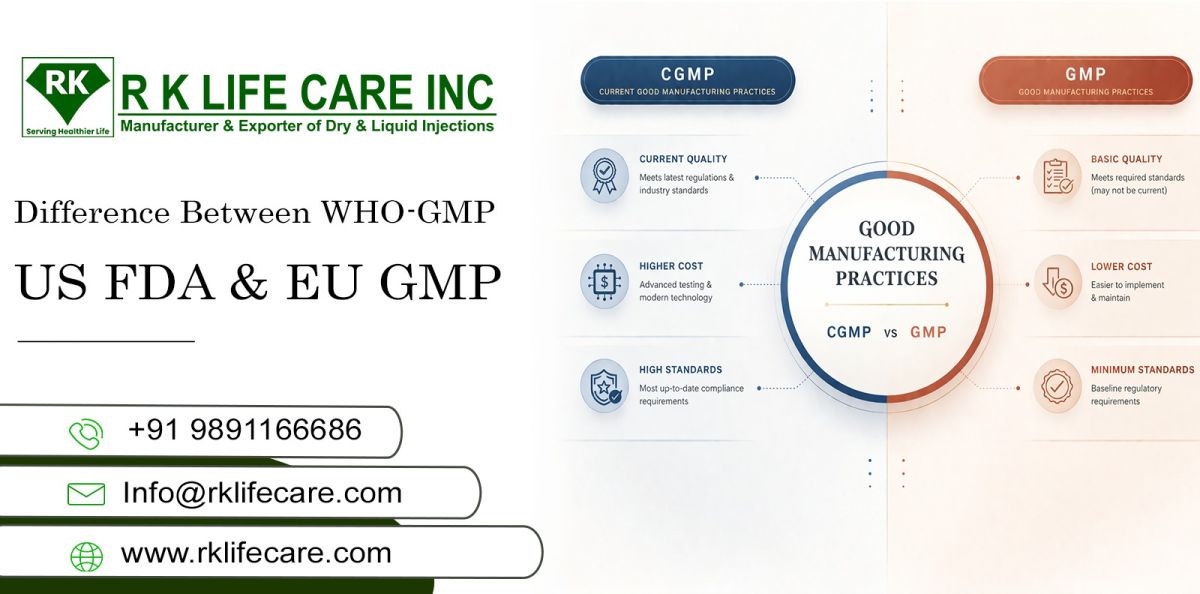
One wrong certification in the pharmaceutical industry can cost you lakhs in delays, rejected shipments, and lost international opportunities.
If you’re planning to manufacture or export medicines, you’ve probably heard terms like WHO-GMP, US FDA, and EU GMP. But the real challenge is not knowing the names—it’s understanding the difference between WHO-GMP, US FDA, and EU GMP and choosing the right one for your business.
Choosing the wrong certification can increase your costs, delay approvals, and even block your entry into international markets. That’s why understanding these standards in a clear and practical way is extremely important.
What is GMP in Pharmaceuticals?
GMP (Good Manufacturing Practices) is a system designed to ensure that medicines are consistently produced and controlled according to strict quality standards.
In simple terms, GMP makes sure that:
- Medicines are safe for consumption
- Products are manufactured in clean and controlled environments
- Every batch has the same quality and effectiveness
GMP covers important areas like:
- Raw material quality checking
- Manufacturing process control
- Hygiene and sanitation of facilities
- Staff training and responsibilities
- Proper documentation and record keeping
Without GMP, there is a high risk of contamination, errors, or poor-quality medicines.
What is WHO-GMP?
WHO-GMP is a certification based on guidelines set by the World Health Organization. It is considered the entry-level global standard for pharmaceutical manufacturing.
Explanation in simple terms:
WHO-GMP ensures that a company follows basic but essential quality practices. It focuses more on safety and consistency rather than advanced systems.
Key Points Explained:
- Cost-effective: Suitable for small and medium businesses
- Easier approval process: Compared to the EU GMP and the US FDA
- Widely accepted: Especially in Africa, Asia, and developing countries
- Basic infrastructure requirement: No need for highly advanced systems initially
WHO-GMP is ideal if you want to start your pharmaceutical export journey with a lower investment.
What is US FDA Approval?
The US FDA (United States Food and Drug Administration) is one of the strictest and most advanced regulatory authorities in the world.
Explanation in simple terms:
US FDA doesn’t just check your factory—it checks your entire system, process, and documentation in detail.
Key Points Explained:
- Very strict standards: Even small mistakes can lead to rejection
- Detailed documentation: Every step must be recorded and verified
- Regular inspections: Including surprise inspections
- Product approvals required: Not just facility approval
Achieving US FDA approval means your company meets global premium quality standards, which increases your credibility worldwide.
What is EU GMP?
EU GMP is followed across European Union countries and focuses heavily on quality systems and risk management.
Explanation in simple terms:
EU GMP ensures that companies not only maintain quality but also identify and control risks before problems occur.
Key Points Explained:
- High-quality standards: Similar to the US FDA
- Risk-based approach: Focus on preventing issues
- Qualified Person (QP): A certified expert must approve product release
- Structured system: Strong emphasis on documentation and validation
EU GMP is ideal for businesses targeting European and highly regulated markets.
WHO-GMP vs US FDA vs EU GMP (Detailed Comparison)
Understanding the difference between WHO-GMP, US FDA, and EU GMP helps businesses choose the right certification based on their export goals.
| Factor | WHO-GMP | EU GMP | US FDA |
|---|---|---|---|
| Strictness Level | Basic to Moderate | High | Very High |
| Investment Needed | Low | Medium to High | Very High |
| Approval Process | Relatively Easy | Moderate Complexity | Highly Complex |
| Market Coverage | Developing countries | Europe & Global | USA & Premium Markets |
| Inspection Style | Periodic |
Risk-based structured |
Frequent & strict |
Real-Life Example (Better Understanding)
Let’s understand this with a practical scenario:
- If you want to export medicines to Nigeria or Kenya → WHO-GMP is sufficient
- If you want to export to Germany or Spain → EU GMP is required
- If you want to export to the United States → US FDA approval is mandatory
This clearly shows that certification depends on your target market, not just your capability.
How Companies Choose the Right Certification
Choosing between WHO-GMP, US FDA, and EU GMP depends on your business stage, budget, and target export market.
Most successful pharmaceutical companies follow a step-by-step approach:
- Start with WHO-GMP
- Enter less-regulated markets
- Build revenue and experience
- Upgrade to EU GMP or US FDA
Companies like Rk Life Care Inc often follow this approach by aligning certifications with market needs rather than overinvesting early.
Common Mistakes to Avoid
Many new businesses make avoidable mistakes:
1. Going for the US FDA too early
This increases cost and complexity without guaranteed returns.
2. Ignoring documentation
Even if your product is good, poor documentation can lead to rejection.
3. Not understanding market rules
Each country has different requirements.
4. Underestimating costs
Higher certifications require continuous investment.
Final Thoughts: Choose Smart, Grow Step-by-Step
WHO-GMP, EU GMP, and US FDA are not just certifications—they are levels of growth in the pharmaceutical industry.
- WHO-GMP → Starting stage
- EU GMP → Expansion stage
- US FDA → Global premium stage
Choosing between WHO-GMP, US FDA, and EU GMP should always be based on your long-term business strategy.
Conclusion
If you are planning to enter the pharmaceutical business or expand globally, your first step should be understanding these certifications clearly.
Choose the certification based on:
- Your target market
- Your budget
- Your growth plans
If you're just starting, begin with WHO-GMP and gradually move toward EU GMP or US FDA, based on your target market.
Choosing the right certification at the right time can save you costs, reduce risk, and help you grow faster in the global pharmaceutical industry.
Comments
No comments yet. Be the first to share your thoughts!
Leave a Comment