
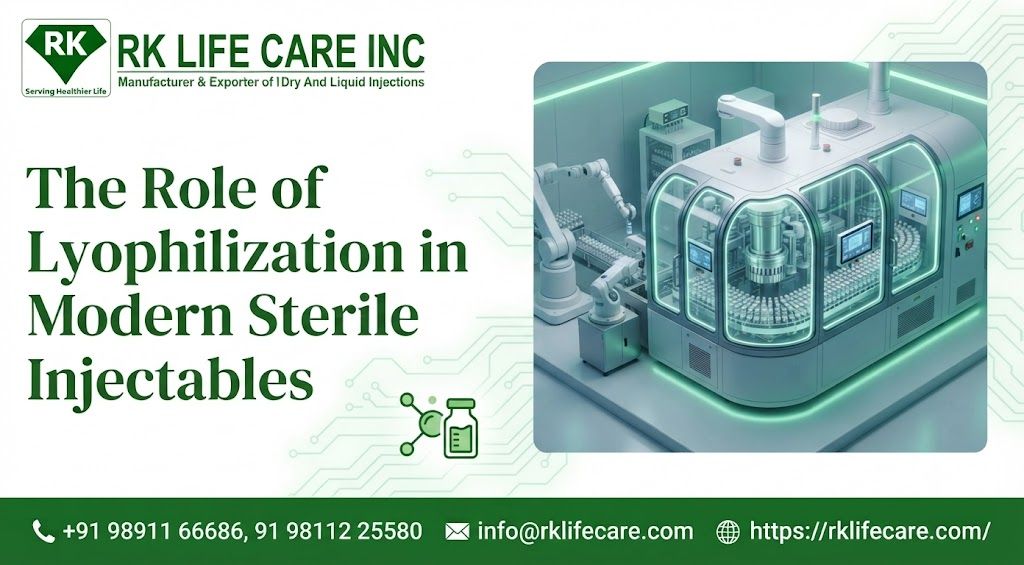
The modern pharmaceutical landscape relies heavily on advanced preservation techniques to ensure that life-saving therapeutic formulations maintain their molecular integrity, structural stability, and clinical potency. Among these technologies, lyophilization—widely recognized as freeze-drying—has transformed the development and delivery of sensitive biopharmaceuticals, complex vaccines, and critical care dry powder injections. Facilities specializing in sterile processing, such as the WHO-GMP and ISO-certified plant operated by RK Life Care Inc in Jhajjar, Haryana, utilize sophisticated lyophilization cycles to bridge the gap between complex chemical engineering and safe clinical application.
Understanding the Lyophilization Process in Pharmaceuticals
Lyophilization is a delicate, multi-stage dehydration procedure executed under deep vacuum conditions. Unlike conventional drying methods that apply thermal energy to evaporate moisture—a process that often damages fragile chemical bonds—freeze-drying removes water through sublimation.
The procedure generally unfolds across three core phases:
-
The Freezing Phase: The liquid pharmaceutical formulation, containing active ingredients, buffers, and cryoprotectants, is cooled below its eutectic point or glass transition temperature to completely solidify the solvent.
-
Primary Drying (Sublimation): A high vacuum is pulled, and controlled heat is introduced. This causes ice crystals within the frozen matrix to transition directly from a solid state into vapor, bypassing the liquid phase entirely and extracting the vast majority of free water.
-
Secondary Drying (Desorption): Bound moisture molecules that adhere to the product matrix are stripped away by raising the temperature incrementally under deep vacuum, reducing residual moisture content to optimal threshold limits (typically below 1% to 3%).
By avoiding high temperatures, the active pharmaceutical ingredients (APIs) remain structurally intact, preserving the therapeutic efficacy of heat-sensitive compounds.
Why Lyophilization is Indispensable for Sterile Injectables
The demand for injectable medications that require high stability has surged due to the rise of complex biologics, oncology drugs, and broad-spectrum antibiotics. Liquid formulations of these molecules frequently suffer from chemical degradation pathways such as hydrolysis, oxidation, or aggregation when stored over long periods. Lyophilization solves these chemical challenges through several distinct mechanisms:
-
Protection of Thermolabile Molecules: Antibiotics, peptides, proteins, and enzymes degrade rapidly when exposed to heat. Freeze-drying allows manufacturers to handle these temperature-sensitive materials safely without losing therapeutic value.
-
Extended Product Shelf Life: Reducing moisture content to trace levels halts degradation reactions. Consequently, vital critical care injections achieve extended commercial shelf lives, simplifying distribution logistics for domestic and international markets.
-
Porous Matrix Formation: The space previously occupied by ice crystals transforms into a highly porous structure often referred to as a "cake." This porous architecture permits rapid and complete reconstitution when a clinician introduces a diluent, allowing the medication to dissolve smoothly within seconds prior to patient administration.
Technical Precision and Clean-Room Engineering
Executing commercial-scale lyophilization requires meticulous environmental controls, specialized equipment, and adherence to strict regulatory frameworks. Because sterile injectables are administered directly into the bloodstream, manufacturing standards leave no room for microbial contamination or particulate inclusion.
Advanced facilities integrate rigorous engineering controls into their production lines:
-
Sterile Core Integrity: Production areas utilize specialized HVAC systems equipped with HEPA filtration to maintain high cleanliness classifications, preventing airborne contamination during vial filling and transfer into freeze-dryers.
-
Advanced Monitoring Systems: Automated loading and unloading systems, precise shelf-temperature mapping devices, and real-time vacuum sensors ensure that every batch experiences uniform thermal treatment and moisture reduction.
-
Strict Quality Assurance (QA/QC): Comprehensive protocols mandate rigorous sterility testing, particulate matter monitoring, container closure integrity testing (CCIT), and stability studies to meet international pharmacopoeia standards.
Meeting Global Standards: The Commitment of RK Life Care Inc
As regulatory expectations tighten across international health authorities, pharmaceutical manufacturers must demonstrate consistent compliance with Good Manufacturing Practices (GMP), current Good Laboratory Practices (GLP), and ISO guidelines. Companies operating modern production units—such as RK Life Care Inc—implement these frameworks to support both domestic healthcare networks and global export channels spanning over 20 countries.
With corporate headquarters in Rohini, New Delhi, and an advanced industrial manufacturing setup located within the Reliance Modern Industrial Area (MET) in Jhajjar, Haryana, the organization focuses on producing a diverse portfolio of human and veterinary dry powder injections. These portfolios span critical care, anti-infectives, and specialized therapeutic segments.
By combining sophisticated lyophilization equipment with skilled scientific personnel, modern plants ensure that every batch of life-saving medicine meets rigid purity criteria before reaching hospitals, clinics, and distribution partners.
Supporting Scalability Through Contract and Third-Party Manufacturing
The complexity and high capital expenditure required to install and validate commercial lyophilizers present significant barriers for many emerging pharmaceutical brands. To overcome this hurdle, industry participants increasingly rely on specialized partnership models:
-
Third-Party Manufacturing: Established producers allow marketing companies to outsource production, reducing overhead costs while guaranteeing access to validated, certified manufacturing lines.
-
Contract Manufacturing & Private Labeling: Collaborative agreements enable brands to scale their product volume rapidly, utilizing existing sterile powder filling and freeze-drying infrastructure without constructing dedicated plants.
-
Regulatory Dossier Support: Comprehensive documentation, including Common Technical Document (CTD) dossiers, Drug Master Files (DMF), and stability validation data, helps partners navigate foreign market entry smoothly.
Conclusion
Lyophilization remains an irreplaceable pillar of contemporary pharmaceutical engineering, safeguarding the viability of fragile molecules that sustain global healthcare systems. As medical treatments advance toward more targeted, heat-sensitive formulations, the reliance on precise freeze-drying technology will only intensify. Through continuous adherence to stringent quality control, technological refinement, and regulatory compliance, specialized manufacturers continue to drive the reliable delivery of high-purity sterile injectables to patients worldwide.
Comments
No comments yet. Be the first to share your thoughts!
Leave a Comment