
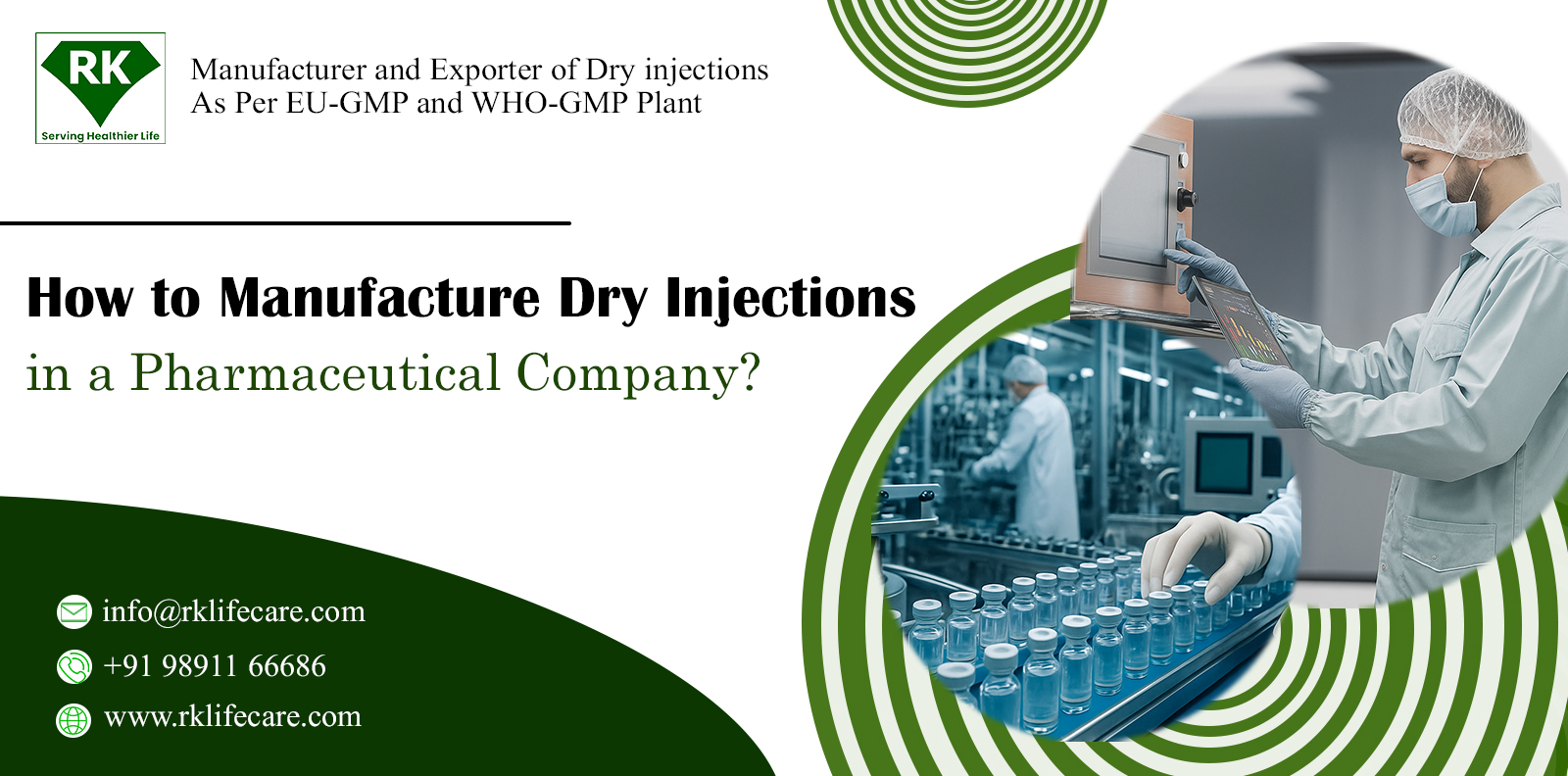
Dry injections, also known as lyophilized or sterile powder injections, are widely used in hospitals due to their greater stability, longer shelf life, and rapid preparation before use. The manufacturing of dry injections requires strict adherence to WHO-GMP and EU-GMP guidelines, a controlled environment, and validated processes.
1. Raw Material Procurement and Quality Control

The manufacturing process begins with the procurement of active pharmaceutical ingredients (APIs) and pharmaceutical-grade excipients from approved and qualified vendors. Each raw material undergoes rigorous quality control testing in the quality control (QC) laboratory. Testing includes identification, purity, potency, microbial limits, and compliance with pharmacopoeial standards such as IP, BP, USP, or EP. Only materials that meet the predetermined specifications are released for production.
2. Water for Injection (WFI) Preparation
Water for Injection (WFI) is a crucial component in the manufacture of dry injectable drugs. It is produced through reverse osmosis, deionization, and distillation processes to ensure high purity. WFI is stored and circulated in a closed-loop system maintained at controlled temperatures to prevent microbial growth. Regular monitoring ensures compliance with conductivity, TOC, and endotoxin limits.
3. Solution Preparation
In this stage, the approved APIs and excipients are dissolved in Water for Injection (WFI) in a stainless steel mixing vessel under aseptic conditions. The solution is prepared according to a validated batch manufacturing record (BMR). Parameters such as pH, temperature, mixing speed, and solution clarity are carefully monitored. The prepared solution is filtered through a pre-filter to remove visible particles before sterile filtration.
4. Sterile Filtration
Sterile filtration is performed using a validated 0.22-micron membrane filter to remove microorganisms. This step is crucial for achieving sterility without applying heat, as heat can degrade heat-sensitive APIs. Filter integrity tests, such as bubble point testing, are performed before and after filtration to confirm the filter's performance. The sterile-filtered solution is then transferred to the filling area without any contamination.
5. Aseptic Filling into Vials
The sterile solution is filled into depyrogenated glass vials using automatic or semi-automatic filling machines in a Grade A (laminar airflow) and Grade B background environment. The filling volume is precisely controlled to ensure dose accuracy. Throughout the entire process, environmental monitoring is performed to ensure that particulate and microbial levels remain within acceptable limits.
6. Lyophilization (Freeze Drying)
After filling, the vials are partially stoppered and loaded into a lyophilizer (freeze dryer). The lyophilization process consists of three main stages: freezing, primary drying (sublimation), and secondary drying (desorption). This process removes water from the product while maintaining its chemical and physical stability. The cycle parameters are validated to ensure consistent product quality.
7. Vial Stoppering and Sealing
Once lyophilization is complete, the vials are sealed completely inside the lyophilizer under vacuum or an inert gas atmosphere. The vials are then transferred to automatic sealing machines for sealing with aluminum flip-off caps. This ensures the integrity of the container closure and protects the product from contamination and moisture ingress.
8. Visual Inspection
Every sealed vial undergoes 100% visual inspection to detect particulate matter, cracks, incomplete seals, or cosmetic defects. The inspection can be performed manually or using automated inspection machines. Defective units are segregated and documented according to GMP procedures.
9. Quality Control Testing
The finished dry injection vials undergo comprehensive QC testing. The tests include sterility, bacterial endotoxin, assay, related substances, moisture content, pH after reconstitution, and particulate matter. Stability studies are conducted to determine the shelf life according to ICH guidelines.
10. Labeling, Packaging, and Distribution
Approved batches are labeled, packaged, and stored under controlled conditions. Packaging materials are verified before use, and batch traceability is maintained. The finished products are then distributed to domestic and international markets in accordance with regulatory requirements.
Conclusion
Manufacturing dry injections in a pharmaceutical company is a highly controlled and validated process that ensures safety, efficacy, and quality. By adhering to GMP standards, validated systems, and robust quality control, pharmaceutical manufacturers can provide reliable dry injection products to meet healthcare needs worldwide.
Comments
No comments yet. Be the first to share your thoughts!
Leave a Comment