
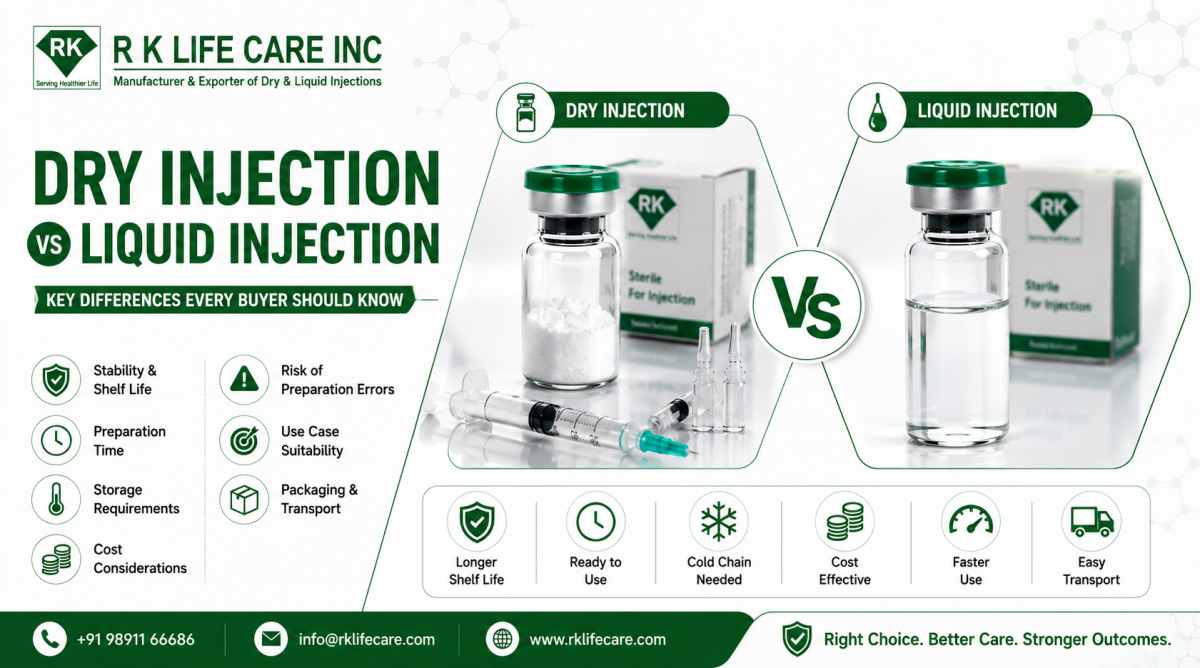
Injectable medications come in two broad forms: dry (lyophilized) powder injections that need reconstitution before use, and liquid injections that are ready to administer straight from the vial or ampoule. Both are widely used across hospitals, clinics, and pharmacies, but they differ in stability, handling, cost, and convenience. For buyers — whether a hospital procurement team, a pharmacy, or a distributor — understanding these differences helps in making the right purchasing and storage decisions.
At RK Life Care Inc, this is a question we hear often from pharmacy partners and healthcare buyers, so here's a clear breakdown of what actually separates the two.
What Is a Dry (Powder) Injection?
A dry injection is a freeze-dried or powder form of a drug that must be reconstituted with a diluent — usually water for injection, saline, or a specific solvent — before it can be administered. This process is used when the active drug is chemically unstable in liquid form over long periods.
What Is a Liquid Injection?
A liquid injection is a drug that is already dissolved or suspended in a solvent and packaged ready-to-use. No mixing or preparation is required beyond drawing up the correct dose.
Key Differences
1. Stability and Shelf Life
Dry powders are generally more stable and have a longer shelf life because the absence of water slows down degradation reactions. Liquid injections, being already in solution, are more prone to degradation over time, which is why many sensitive drugs (like certain antibiotics and biologics) are only available in powder form.
2. Preparation Time
Liquid injections can be administered almost immediately after drawing the dose. Dry injections require an extra reconstitution step — measuring diluent, mixing, and checking for complete dissolution — which takes more time and trained handling.
3. Storage Requirements
Dry powders are often more forgiving with storage conditions and can sometimes be kept at room temperature, whereas many liquid formulations, especially biologics, require continuous cold-chain storage (refrigeration) from manufacturing to administration.
4. Cost Considerations
Liquid injections typically cost less to produce since they skip the lyophilization (freeze-drying) process, which is energy- and equipment-intensive. Dry injections often carry a higher manufacturing cost, which can be reflected in pricing.
5. Risk of Preparation Errors
Because reconstitution involves multiple steps — selecting the correct diluent, measuring accurate volumes, and mixing correctly — dry injections carry a slightly higher risk of human error during preparation compared to liquid injections, which are used as-is.
6. Use Case Suitability
Liquid injections are often preferred in high-volume, fast-paced settings (like emergency rooms) where speed matters. Dry injections are common for drugs with limited stability in solution, such as many antibiotics, certain hormones, and biologic therapies.
7. Packaging and Transport
Dry injections are generally lighter and more transport-friendly since they don't carry liquid volume, and they're less vulnerable to damage from freezing or temperature fluctuations during transit.
Quick Comparison Table
| Factor | Dry Injection | Liquid Injection |
|---|---|---|
| Liquid Injection | Yes (reconstitution) | No |
| Shelf life | Generally longer | Generally shorter |
| Storage flexibility | Often more flexible | Often requires cold chain |
| Manufacturing cost | Higher | Lower |
| Speed of administration | Slower | Faster |
| Risk of prep error | Slightly higher | Lower |
Which One Should Buyers Choose?
There's no universal "better" option — it depends on the drug, the setting, and logistical capacity. A hospital pharmacy with trained staff and proper storage may comfortably stock dry injections for sensitive drugs, while a smaller clinic prioritizing speed and simplicity might lean toward liquid formulations where available.
At RK Life Care Inc, our product range includes both dry powder and liquid injectable formulations, so buyers can choose based on what best fits their clinical needs, storage capacity, and handling resources — rather than being limited to one format.
Final Thoughts
Both dry and liquid injections have their place in modern healthcare, and the right choice comes down to drug stability, storage infrastructure, and how the medication will be used in practice. Buyers who understand these differences are better equipped to make informed procurement decisions that balance cost, convenience, and patient safety.
Comments
No comments yet. Be the first to share your thoughts!
Leave a Comment