
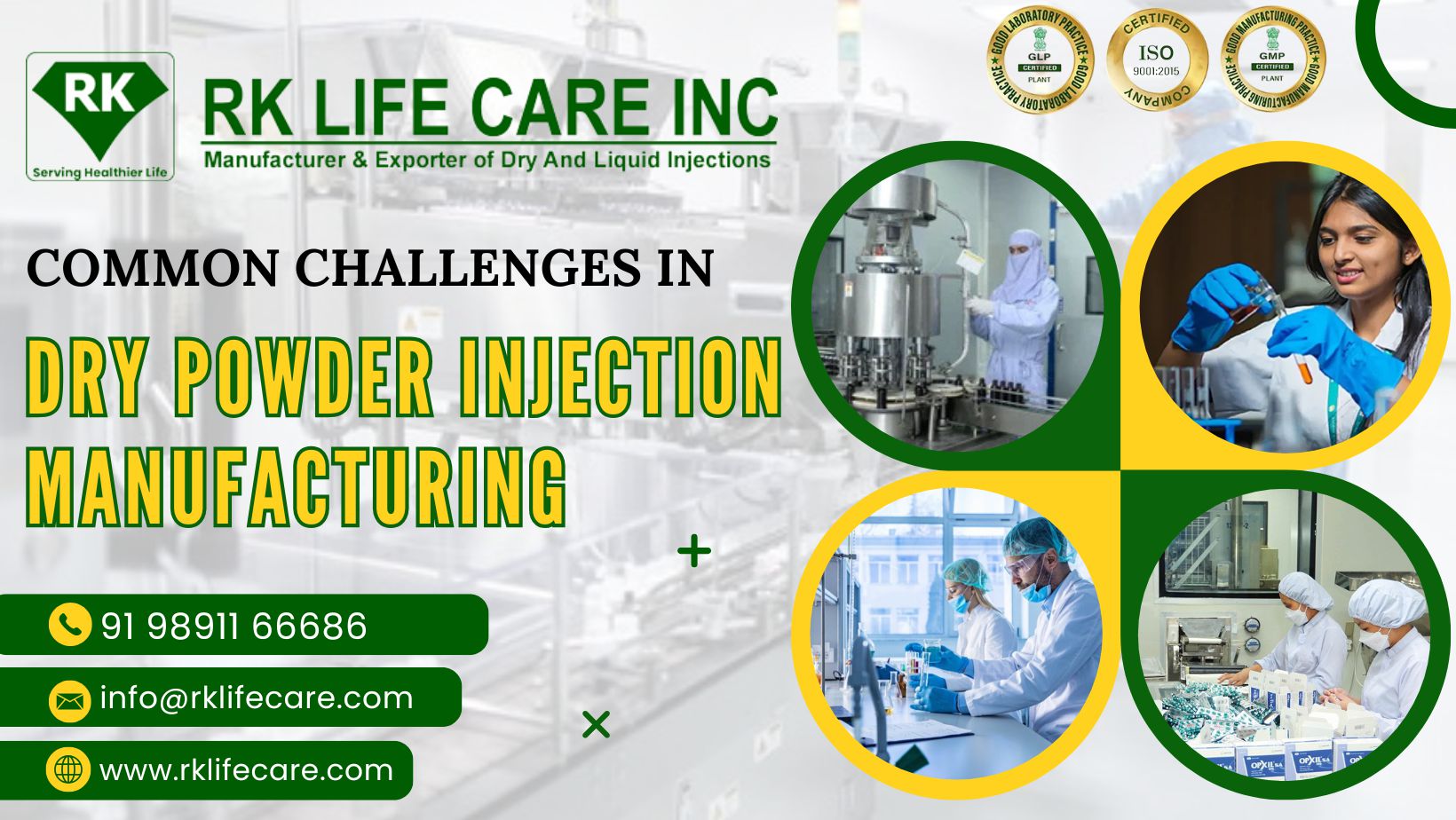
Dry powder injection manufacturing plays a crucial role in the pharmaceutical industry, especially for drugs that are unstable in liquid form. These formulations are widely used for antibiotics, biologics, and vaccines, offering improved shelf life and stability. However, the manufacturing process is complex and requires strict adherence to quality, safety, and regulatory standards. Despite technological advancements, manufacturers continue to face several challenges that can impact efficiency, product quality, and compliance.
1. Maintaining Sterility and Contamination Control
One of the most critical challenges in dry powder injection manufacturing is ensuring sterility throughout the production process. Since these products are administered directly into the body, even minor contamination can have serious consequences.
Manufacturers must operate in highly controlled cleanroom environments, using advanced filtration systems and aseptic techniques. However, maintaining these conditions consistently is not easy. Factors such as human intervention, equipment design, and environmental fluctuations can introduce contamination risks.
Organizations such as Rk Life Care Inc focus heavily on maintaining strict sterile protocols and continuous monitoring systems to minimize such risks while ensuring consistent product quality.
2. Powder Flow and Uniformity Issues
Dry powders often exhibit poor flow properties, which can lead to inconsistent filling during vial or ampoule packaging. Achieving uniformity in dosage is crucial, especially for potent drugs where slight variations can affect efficacy or safety.
Powder characteristics such as particle size, shape, and moisture content significantly influence flow behavior. Manufacturers must carefully optimize formulations and use specialized equipment to ensure consistent dosing.
In practice, companies like Rk Life Care Inc work on formulation optimization and process control strategies to improve powder handling efficiency without compromising dosage accuracy.
3. Moisture Sensitivity
Many dry powder formulations are highly sensitive to moisture. Exposure to humidity during manufacturing, storage, or transportation can compromise product stability and reduce shelf life.
Controlling environmental humidity requires sophisticated HVAC systems and dehumidifiers, which increase infrastructure costs. Additionally, packaging must provide strong moisture barriers.
Pharmaceutical manufacturers, including Rk Life Care Inc, invest in controlled environments and advanced packaging solutions to maintain product integrity throughout the lifecycle.
4. Complex Equipment and Maintenance
The manufacturing of dry powder injections involves specialized equipment such as lyophilizers (freeze dryers), sterile filling machines, and powder handling systems. These machines must operate with high precision and reliability.
However, maintaining and calibrating such equipment is both time-consuming and expensive. Downtime due to equipment failure can disrupt production schedules and lead to financial losses.
Companies like Rk Life Care Inc emphasize preventive maintenance and equipment validation to ensure uninterrupted production and compliance with industry standards.
5. Regulatory Compliance
Pharmaceutical manufacturing is heavily regulated, and dry powder injections are no exception. Companies must comply with guidelines set by authorities such as the FDA, EMA, and WHO.
Keeping up with evolving regulatory requirements can be challenging, particularly for manufacturers operating in multiple markets. Documentation, audits, and validation processes require significant resources.
Established players like Rk Life Care Inc prioritize regulatory alignment and documentation practices to meet global compliance standards efficiently.
6. Scale-Up Challenges
Transitioning from laboratory-scale production to commercial-scale manufacturing is another major hurdle. Processes that work efficiently in small batches may not perform the same way when scaled up.
Manufacturers must conduct extensive trials and optimization studies to ensure consistency. This process can be both time-intensive and costly.
To tackle this, companies such as Rk Life Care Inc focus on scalable process design and pilot testing to ensure smooth transitions from R&D to large-scale production.
7. Skilled Workforce Requirements
Dry powder injection manufacturing demands a highly skilled workforce with expertise in aseptic processing, equipment handling, and quality control. However, finding and retaining such talent can be difficult.
Training employees to meet stringent industry standards requires time and investment. Additionally, human error remains a risk factor despite training.
Organizations like Rk Life Care Inc invest in continuous training programs and standard operating procedures (SOPs) to build a competent and reliable workforce.
8. Cost Management
Balancing quality with cost efficiency is an ongoing challenge. The need for advanced infrastructure, specialized equipment, and strict compliance measures drives up production costs.
Manufacturers must find ways to optimize processes without compromising quality. This often involves adopting new technologies and improving supply chain management.
Companies such as Rk Life Care Inc continuously refine their operations to maintain cost efficiency while delivering high-quality pharmaceutical products.
9. Packaging and Stability Concerns
Packaging plays a vital role in preserving the integrity of dry powder injections. Vials, stoppers, and seals must protect the product from moisture, light, and contamination.
Selecting the right packaging materials and ensuring compatibility with the drug formulation can be challenging. Stability testing is required to confirm long-term effectiveness.
Manufacturers, including Rk Life Care Inc, prioritize robust packaging solutions and thorough stability studies to ensure product safety and longevity.
10. Technological Integration
As the pharmaceutical industry moves toward automation and digitalization, integrating new technologies into existing manufacturing systems can be difficult.
While automation can improve efficiency and reduce human error, it requires significant investment and expertise.
Forward-thinking companies like Rk Life Care Inc are gradually adopting advanced technologies to enhance production efficiency and quality assurance without disrupting existing systems.
Conclusion
Dry powder injection manufacturing is a highly specialized field that comes with its own set of challenges. From maintaining sterility and managing moisture sensitivity to ensuring regulatory compliance and controlling costs, manufacturers must navigate a complex landscape.
With the support of advanced technology, skilled professionals, and strong operational practices, companies such as Rk Life Care Inc are contributing to overcoming these challenges while ensuring the delivery of safe, effective, and high-quality pharmaceutical products.
Comments
No comments yet. Be the first to share your thoughts!
Leave a Comment